





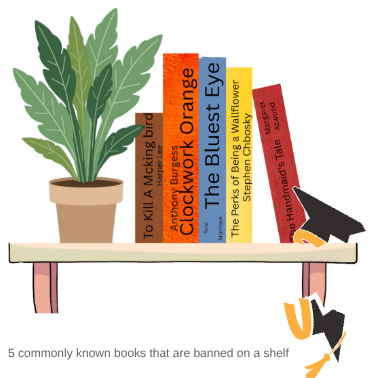
The United States has banned books since colonial times. Back then, this action was nearly equivalent to burning the supply of knowledge; however, now the outcome may not be so destructive.
A book named New English Canaan or New Canaan was published in 1637 in Amsterdam and would later be banned in what would become the United States, according to LibNews. Ever since, the number of books prohibited each year has only grown.
In the years 2021-2025, around 23,000 books were banned in public schools nationwide, according to PEN America. That is, on average, 4,000 books per year, or about 16 books a day. The top book banned in schools in 2025 was Anthony Burgess’s A Clockwork Orange, banned 23 times despite making Times Magazine’s top 100 books of the century, according to PEN America. With so many bans in just four years, people may wonder why. Books are banned for a multitude of reasons, from going against a community’s religious views to violating basic societal norms to just being deemed inappropriate.
Books can be banned on many levels, the most common being the school level. School districts ban books all the time, so these actions may seem like a non-issue. However, the problem is that the reasons they give to restrict books seem to be illogical to some people. Anthony Rivera, English teacher, said, “All banning does is take away the hard truth without fixing any problems, because they are a form of knowledge; all banning them does is degrade society”.
In a survey by PEN America, results showed that over 80 percent of books banned in the 2023-2024 school year contained characters that are of another race and/or the LGBTQ+ community. One widely known example of this occurrence is Margaret Atwood’s The Handmaid’s Tale, which follows an infertile woman without a husband assigned to care for children. Even books that are not banned still have limited access due to the requirement of administrative approval and signed permission slips to read the books.
Information in the literary world has become more heavily censored in the last decade. According to ACLU, “In 2021, the American Library Association recorded 729 book challenges, compared to 156 challenges received the year prior,” nearly a 470% increase.
Books are said to be banned to stop the spread of inappropriate information to children and adolescents, but that may not be all there is to it. Censorship does not end at books, so where is the line and who draws it?
Kaydyn Beasley • Feb 27, 2026 at 12:01 pm
Wow I’m so impressed by your knowledge on this topic.