











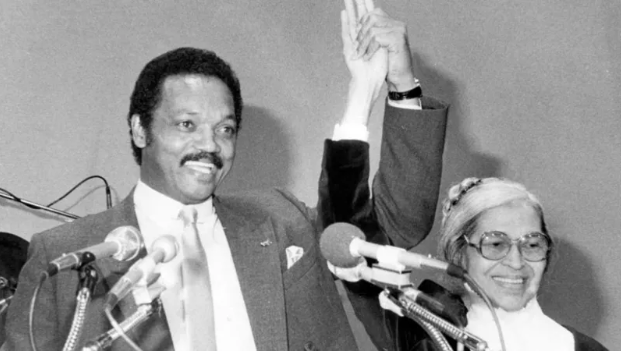
The collective action symbolized by Martin Luther King Jr. survived his passing and was developed further by a hidden figure of unity within his circle: Jesse Jackson.
Jesse Jackson, formally Jesse Louis Burns, was born on Oct. 8, 1941. According to Britannica, he was the product of an affair between a female high schooler, Helen Burns, and Noah Robinson, a married next-door neighbor. Burns married Charles Jackson soon after Jesse’s birth, and he was Jesse’s father figure throughout childhood; Jesse took Charles’s last name and became Jesse Jackson.
Jesse Jackson was a go-getter in high school. Not only was he an honor student and class president, but was also a football player who earned himself a scholarship to the University of Illinois; he attended for one year, leaving in 1960. He soon transferred to North Carolina Agricultural & Technical College in Greensboro, N.C., where he met his wife, Jacqueline Lavinia Brown.
It is around this time that Jackson became more involved in activism. He participated in a “read-in” at a local segregated library in Greensville. According to the Zinn Education Project, he and a group of seven other black individuals, now recognized as the Greenville Eight, walked into a whites-only library and demanded that they be allowed to borrow books. This led to his and seven others’ arrests and indictments for disorderly conduct, though this act of protest wasn’t in vain. The library was temporarily shut down, and when it reopened, it was no longer whites-only.
Jackson migrated to Selma, Alabama, where he became a part of the Southern Christian Leadership Conference (SCLC). Martin Luther King Jr., already knowing of Jackson’s previous indictment, made him the leader of Operation Breadbasket. Operation Breadbasket was a part of the SCLC that focused on economic issues.
After King’s tragic passing, Jackson left the SCLC and started an organization of his own: Operation PUSH (People United to Save Humanity). According to Britannica, this new organization was created to help with drug addiction and crime amongst black teens. It also went against prejudiced business practices. It was through this operation that large corporate entities like Standard Oil investigated business practices that hurt the black community.
He didn’t stop there, however; he expanded his agenda and created another organization named the National Rainbow Coalition, which later merged with PUSH to become the Rainbow PUSH Coalition. This new organization sought equal rights for LGBTQ+ and women in addition to African Americans.
During the establishment of the Rainbow PUSH Coalition, Jackson announced his first campaign for president in 1983. This made him the first major African American candidate for president. He performed strongly but lost with 3.5 million votes. He ran again in the 1988 election, performing even stronger than before with just under 7 million votes, but his campaign was still unsuccessful.
Jesse Jackson lost the presidential race, but he won influence on this modern world, which has produced powerful political figures such as Barack Obama and Alexandria Ocasio-Cortez. He leaves an imprint on the modern world that symbolizes defiance, perseverance, and unity.