




Free speech in America is increasingly challenged, with comedians, reporters, politicians, and even civilians facing backlash and disruption for controversial statements and opinions.
From late-night host Jimmy Kimmel’s show being canceled for simple jokes against the president to random men being arrested for publicly speaking out against famous activists, examples of speech being shut down are everywhere these days. Both liberals and conservatives face backlash when they share opinions, showing how sensitive the world has become. Instead of fostering open debate, public discourse often ends with cancellation, protests, arrests, or censorship. Many now wonder if Americans are truly free to say what they believe without fear of consequences.
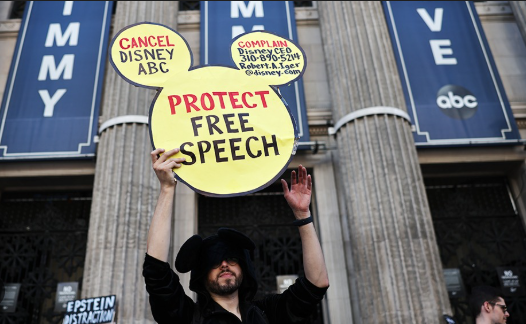
The controversy surrounding Kimmel is one of the most recent and talked-about examples. On Sept.17, ABC suspended Jimmy Kimmel Live! after Kimmel made jokes about President Donald Trump and conservative activist Charlie Kirk during a monologue. The suspension “sparked shock and fears for free speech,” according to The Guardian, as many questioned whether government pressure played a role. Kimmel returned to television on Sept. 23, using his opening monologue to defend free speech. “This show is not important,” he said. “What’s important is that we get to live in a country that allows us to have a show like this.”
His comments reminded viewers that late-night comedy has always been a space for political commentary, and silencing that undermines what democracy stands for. Other television hosts rallied behind him. Several individuals called Trump’s actions “autocratic censorship” and warned that if comedians could be punished for satire, ordinary Americans might be next, according to Politico.
For many, the Kimmel incident was the last straw, highlighting how fragile the idea of free expression has become. But the problem isn’t limited to television. Across the country, ordinary citizens are facing serious consequences for speaking out. On March 8, a Columbia University student named Mahmoud Khalil was detained after participating in a pro-Palestinian protest. His arrest raised “fears of selective prosecution” and drew criticism from civil rights organizations, who argued that his detention was politically motivated, according to AP News.
Melissa Zimmerman, Government teacher, said she isn’t afraid to share her opinions but is mindful of who she shares them with. “People are definitely hesitant to say some things because they’re afraid of what the response may be,” she said. “One of the most amazing things about being in a country that’s free is having free speech, and when the government retaliates against free speech, that becomes a concern,” Zimmerman said. She added that a big difference between the two political parties is that “one party is dominating, using the government to censor, where the other side doesn’t have that power, so they both disagree with each other and don’t handle it well, but we should be able to come together at the end.”
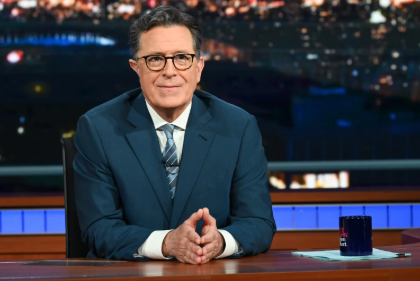
Adding to the growing concerns, Stephen Colbert’s show, The Late Show with Stephen Colbert was abruptly canceled by CBS in July. The network cited financial reasons for the decision, but several critics suspect political motivations, especially after Colbert criticized a $16 million settlement between CBS’s parent company, Paramount Global, and President Trump. The cancellation sparked accusations of political censorship, with some viewing it as a direct response to Colbert’s outspoken criticism of the current administration.
Many Republicans openly criticize cancel culture, claiming it silences conservative voices. Yet, at times, the party has been guilty of similar actions. For example, after a Young Republicans group chat was leaked containing racist and antisemitic remarks, some Republican leaders dismissed the backlash as an overreaction. Vice President JD Vance suggested the outrage was exaggerated compared to more serious political threats. Meanwhile, other Republican leaders took action, with the New York Republican Party suspending its Young Republicans chapter and Chairman Ed Cox denouncing the “vile language” as unacceptable.
Michael Austin, CEO of the Kansas Black Republican Council, also criticized the remarks, calling them a betrayal of the party’s founding principles. These contrasting responses show the tension within the party: while Republicans publicly oppose cancel culture, they sometimes participate in it or excuse it when it benefits them. This highlights how complicated the issue is and why a true commitment to free speech requires consistent principles across all situations.
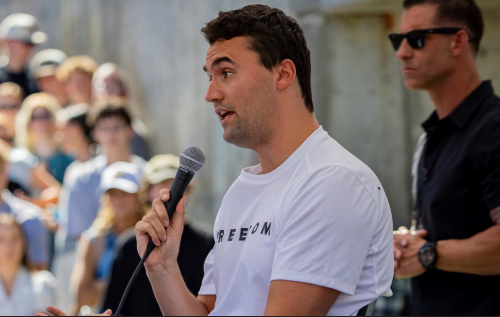
However, free speech challenges have been affecting people across the entire American political spectrum. For instance, conservative activist Charlie Kirk faced intense online attacks and public threats for his commentary, leading to his sudden assasination on Sept. 10. Whether they are being silenced or murdered for their opinions, both political parties continue to blame each other instead of finding a solution.
People who speak out against the government should never be punished, and those who speak in support of it should never be threatened or harmed. Everyone has the right to their own opinion, and both sides of the political spectrum should allow open dialogue without fear of retaliation. True free speech means respecting differing viewpoints and encouraging conversation, not silencing or punishing people for speaking their minds. If America wants to uphold its democratic values, it must protect the right to speak freely, for everyone, regardless of their beliefs.