










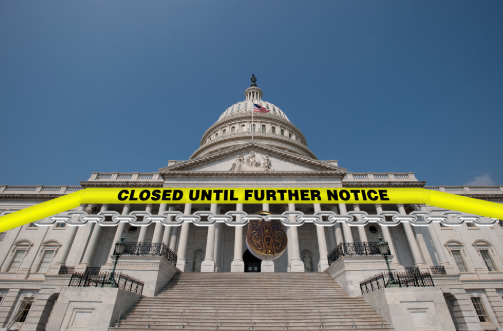
It lasted a month, but the longest government shutdown in U.S. history came to an end, breaking the record set six years ago.
The Senate voted over 14 times to try to agree on funding the government, according to cbsnews.com. Still, Democrats primarily pushed back and continued to vote against the Republican-supported bill that would temporarily fund and reopen the government. Democrats were opposed to eliminating healthcare, so they voted against the funding bill in protest and in order to force the Republicans to renegotiate terms for the Affordable Healthcare Act, which had been cut in a prior bill.
Some federal workers were fired due to the shutdown. Even some veterans were laid off as they were working in Washington D.C. “The shutdown likely led to a loss of 60,000 private-sector jobs,” said Kevin Hassett, Trump’s top economic adviser, according to cnn.com.
One of the reasons the government had been shut down was due to Republicans wanting to get rid of the remainder of Obamacare; however, Democrats were in favor of keeping it. Obamacare, also known as the Affordable Care Act (ACA), was enacted on March 23, 2010, by President Barack Obama for Americans who were struggling to find employment or were uninsured. Matthew Unsworth, U.S. & Arizona History teacher, thinks that healthcare should be affordable for all U.S. citizens. “Even though I am not currently enrolled in the ACA, I would anticipate that my health care costs would go up because all the other costs would go up as well,” Unsworth said. Most people rely on healthcare for doctor’s visits or a dentist, and the cost can range from $300-$600 a month, but “skyrocketing costs … are just around the corner,” according to nbcnews.com.
During the shutdown, the funding for Supplemental Nutrition Assistance Program (SNAP)—better known as food stamps—was delayed, and President Trump refused to add more funding to SNAP until the government reopened. The idea for Food Stamps was introduced in 1939, according to fns.usda.gov. The idea was to help people who were struggling to get food; it was a program created to assist the poor. “I think we live in the richest and most wealthy country in the world, and that we have the ability to feed every person in the United States, as well as many other places around the world. I think we should try to do that rather than deny people food that they need to live,” Unsworth said.
On Nov. 10, the Senate passed a stopgap spending bill 60-40 and allowed the government to reopen. Eight democrats voted to reopen the government because Republicans promised them an eventual vote on Obamacare, according to cbsnews.com. The eight that flipped were Sen. Jeanne Shaheen of New Hampshire, Sen. Dick Durbin of Illinois, Sen. Tim Kaine of Virginia, Sen. Maggie Hassan of New Hampshire, Sen. Angus King of Maine, Sen. Jacky Rosen of Nevada, Sen. Catherine Cortez Masto of Nevada, and Sen. John Fetterman of Pennsylvania. However, the vote that was promised isn’t guaranteed to succeed, and if it doesn’t, then ACA benefits will expire on Dec. 31.
Although the shutdown is over, U.S. citizens enrolled in the ACA still don’t know if the government will allow them to keep their healthcare.